Skills Gap Toolkit
Skills Passport System
AI-Driven Occupation Matching Based on CV Analysis
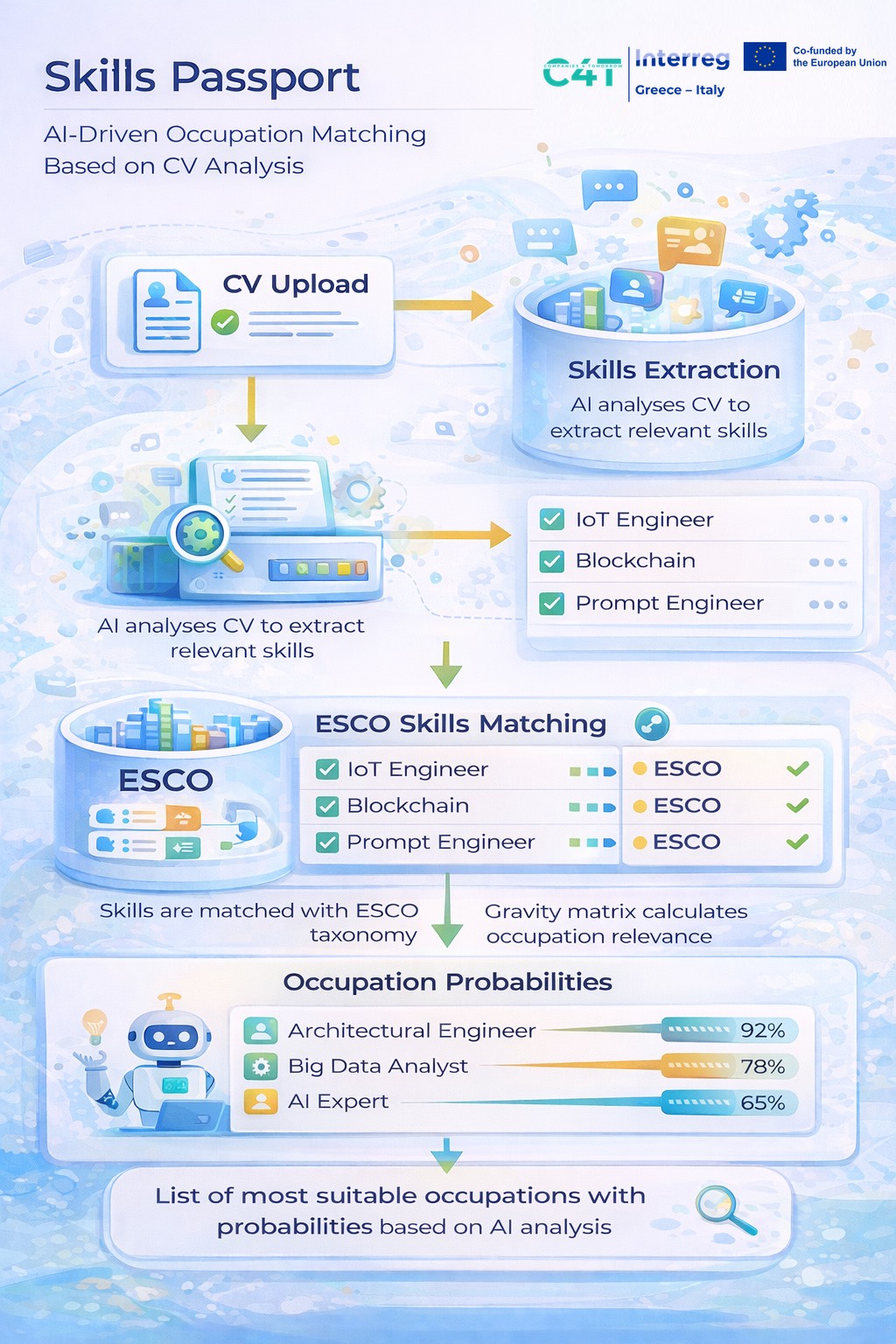
The Skills Passport System is an intelligent tool that helps users identify the occupations that best match their skills. By analyzing a user’s CV using Artificial Intelligence, the system extracts skills, matches them with standardized ESCO classifications, and identifies the most suitable occupations with estimated probabilities.
The Skills Passport supports individuals, training providers, and SMEs by providing a structured overview of skills and career opportunities, based on semantic analysis and European skills standards.
How the Skills Passport Works
- CV Upload
The process begins when the user uploads their Curriculum Vitae (CV) to the platform. The system accepts standard document formats and securely processes the information.
The uploaded CV serves as the main input for the skills analysis process.
- Skills Extraction
After the CV is uploaded, the system performs AI-based text analysis to automatically identify the skills and competences described in the document.
Using Natural Language Processing (NLP) techniques, the system:
- Analyses the content of the CV
- Detects relevant skills and competencies
- Identifies technical and transversal skills
- Extracts experience-related competences
The result is a structured list of identified skills.
Examples of extracted skills may include:
- IoT Engineering
- Blockchain Technologies
- Prompt Engineering
- ESCO Skills Matching
The extracted skills are then matched with the ESCO European Skills Classification.
ESCO provides a standardized taxonomy of:
- Skills
- Occupations
- Competences
Through semantic matching, the system links the detected skills with their corresponding ESCO entries. This ensures consistency and compatibility with European labour market standards.
This step allows the Skills Passport to operate on a standardized and comparable skills framework.
- Occupation Relevance Calculation
Once the ESCO skills have been identified, the system calculates the relevance of different occupations.
This process uses a gravity matrix model, which evaluates how strongly the identified skills are connected to specific occupations.
The gravity matrix considers:
- Required skills per occupation
- Skill importance weights
- Number of matched skills
- Semantic similarity scores
This produces a ranked list of eligible occupations.
- AI-Based Probability Estimation
Artificial Intelligence models are then used to estimate the probability that each occupation matches the user's profile.
The system calculates a suitability score for each occupation based on:
- Skill coverage
- Skill relevance
- Semantic similarity
- Occupation requirements
Example output may include:
- Architectural Engineer – 92%
- Big Data Analyst – 78%
- AI Expert – 65%
- Results Presentation
The final output of the Skills Passport is a structured list of the most suitable occupations, accompanied by probability scores.
The results allow users to:
- Understand their skills profile
- Identify suitable career paths
- Discover new occupational opportunities
- Recognize missing skills
- Plan further training
Key Features
- AI-based CV analysis
- Automatic skills extraction
- ESCO-based skill classification
- Semantic skills matching
- Occupation relevance ranking
- Probability-based occupation recommendations
Benefits
The Skills Passport provides:
- Personalized career guidance
- Evidence-based occupation matching
- Alignment with European standards (ESCO)
- Support for reskilling and upskilling
- Improved labour market matching