Skills Gap Toolkit
Skills Gap Process
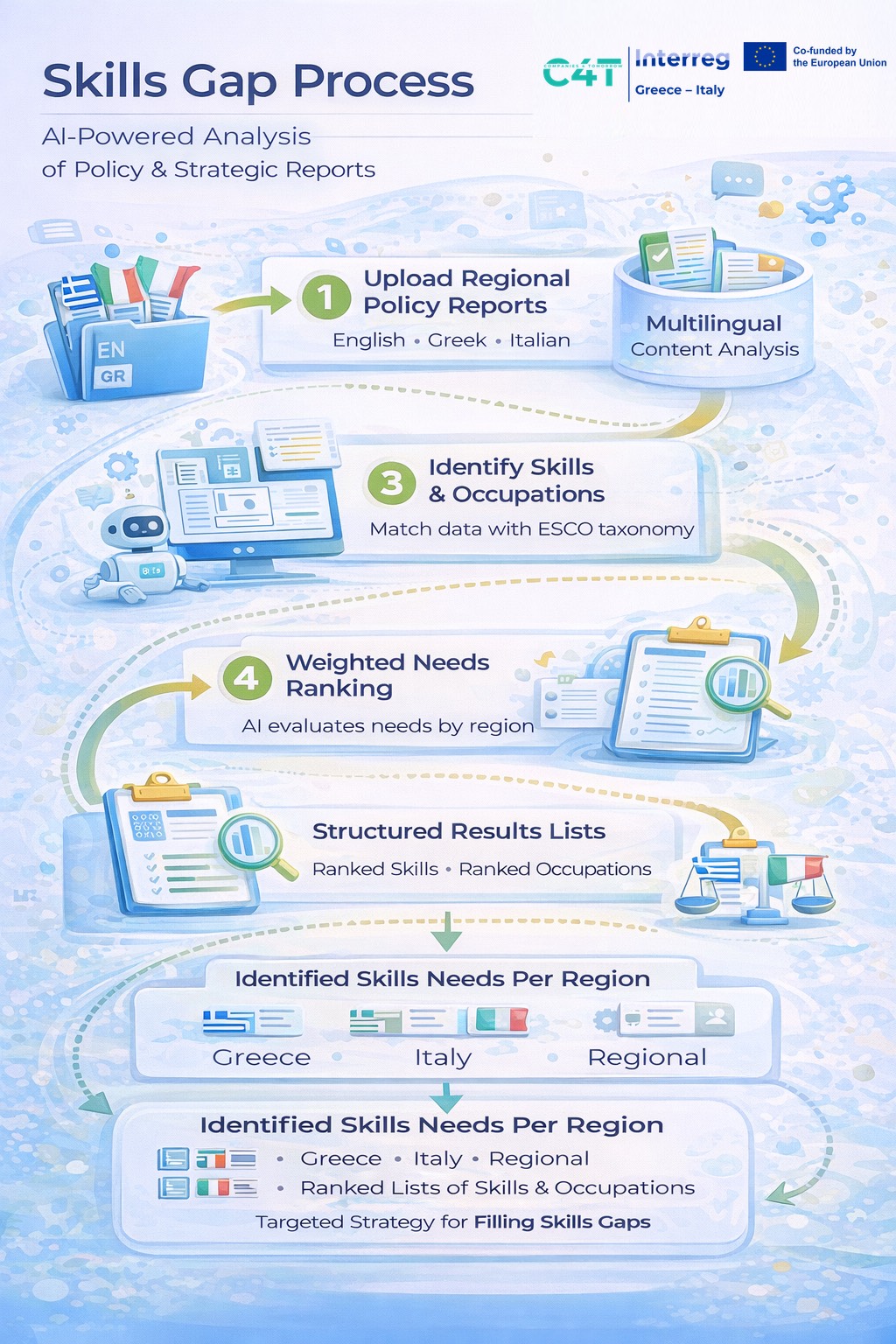
The Skills Gap Process is designed to identify current and future skills needs in the participating regions by analyzing policy and strategic documents using artificial intelligence methods.
The process begins with the collection and upload of policy reports and strategic documents related to economic development, digital transformation, and SME support. Documents can be submitted in English, Greek, and Italian, allowing the system to capture region-specific priorities and policies.
Once uploaded, the system performs automatic content analysis using AI-based natural language processing techniques. The textual content is processed to identify key themes, emerging trends, and priority areas relevant to regional development and SME innovation.
The system then extracts relevant skills, competencies, and occupations mentioned or implied in the documents. Through semantic matching, these elements are linked to the ESCO taxonomy of skills and occupations, ensuring standardized classification and comparability across regions.
Using AI-driven analysis, the platform identifies:
- Priority skills required in each region
- Emerging occupational profiles
- Sector-specific competence needs
- Digital and green skills requirements
The extracted information is then processed through a weighting and ranking mechanism, which evaluates the importance of each skill and occupation based on factors such as:
- Frequency of appearance in policy documents
- Strategic importance in regional plans
- Relevance to SME development
- Cross-document consistency
- Semantic relevance scores
The final output is presented in a structured and user-friendly format, including:
- Ranked lists of priority skills per region
- Ranked lists of relevant occupations
- Associated ESCO classifications
- Comparative results between regions
- Visual summaries and statistics
This process enables policymakers, SMEs, and training providers to identify skills gaps and training priorities, supporting evidence-based decision making and targeted capacity-building actions.
The Skills Gap Process serves as a key component of the Companies for Tomorrow (C4T) platform, linking policy analysis with training design, skills development, and labour market matching tools.